Can you trust Gemini Decision 1's confidence score? I tested it on 400 questions.
Shweta Bhatt · 22 November 2026 · 6 minute read
What is this post about?
On 11 November 2026 Google released Gemini Decision 1, a model that does not write text. You give it something to read and ask a question, and it replies with a number: how likely the answer is "yes".
Google describes it as built for "fast, calibrated binary, categorical, and rubric decisions". A calibrated model is one whose number is honest, which means that when it says it is 90% sure, it should be right about 9 times out of 10. Google's guide suggests checking this with your own labelled examples. Therefore, I ran that check myself.
In this post we will look into two questions I wanted answered before using the model for real work:
- Can I trust its confidence? When it says it is sure, is it right?
- Is it consistent? If I ask the same thing a different way, do I get the same answer?
TL;DR
- Across 400 questions, the model's stated confidence matched how often it was right, at every level from "barely sure" to "almost certain".
- It got 91.5% right, while always answering "yes" would have scored 63%.
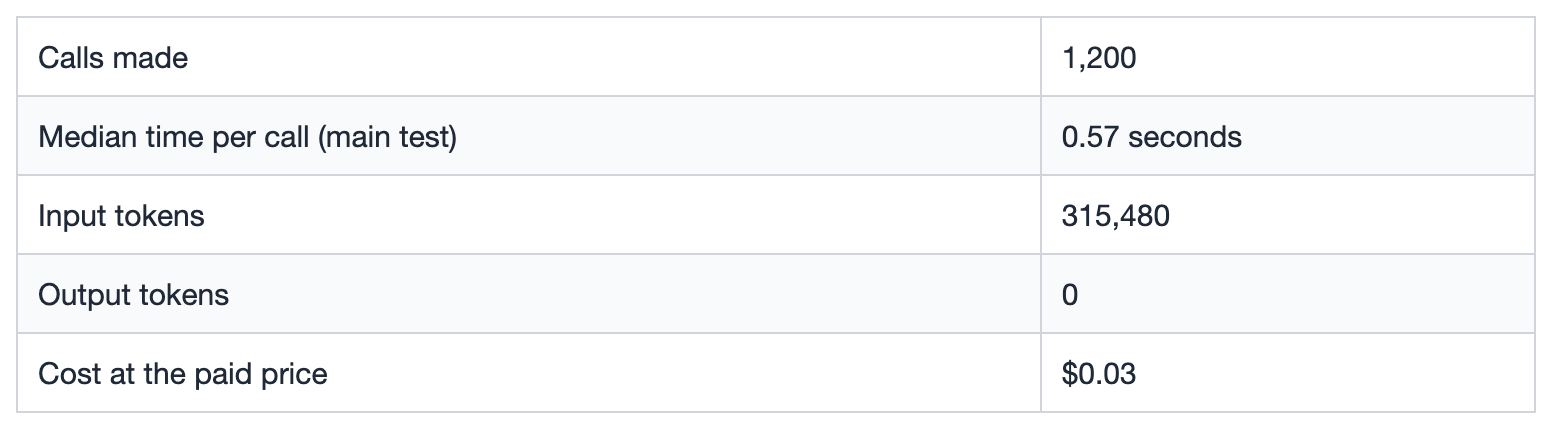
- Each call took about half a second. The whole test cost about 3 cents at the paid price, and nothing on the free tier.
- Bundling questions is safe. A question got exactly the same answer alone as it did alongside two others, on all 400.
- I asked each question and then its opposite. The two answers did not line up on 24 of 400, and only 1 of those was a question the model was at least 90% sure about.
- My rule is to let it decide alone when it is at least 90% sure, send the rest to a person or a bigger model, and try the questions on a sample first.
What is Gemini Decision 1?
Most language models are writers. You send a prompt and they compose a reply, one word after another. Even if you only wanted a yes or a no, you get a sentence back, and your code has to read that sentence to find the answer.
Gemini Decision 1 is a model for the cases where you do not want writing at all. Let's take a few examples: is this message urgent, which team should get it, does this document meet the policy. In each case you want a decision your code can act on. The model reads what you send, considers the questions you attach, and returns a number for each one. It never produces text.
- You send one input (text, an image, audio, video or a PDF) plus up to 1,000 questions about it in the same request.
- A question can be a yes or no, a pick from a list, or a score against a scale.
- Each answer comes with how likely it is, so you can tell a firm "yes" from a shaky one.
- It is free on the free tier. On the paid tier it costs $0.10 per million input tokens, with nothing charged for output.
Google's pages do not label it as stable or preview, and the changelog only says "Released".
How is it different from an ordinary language model?
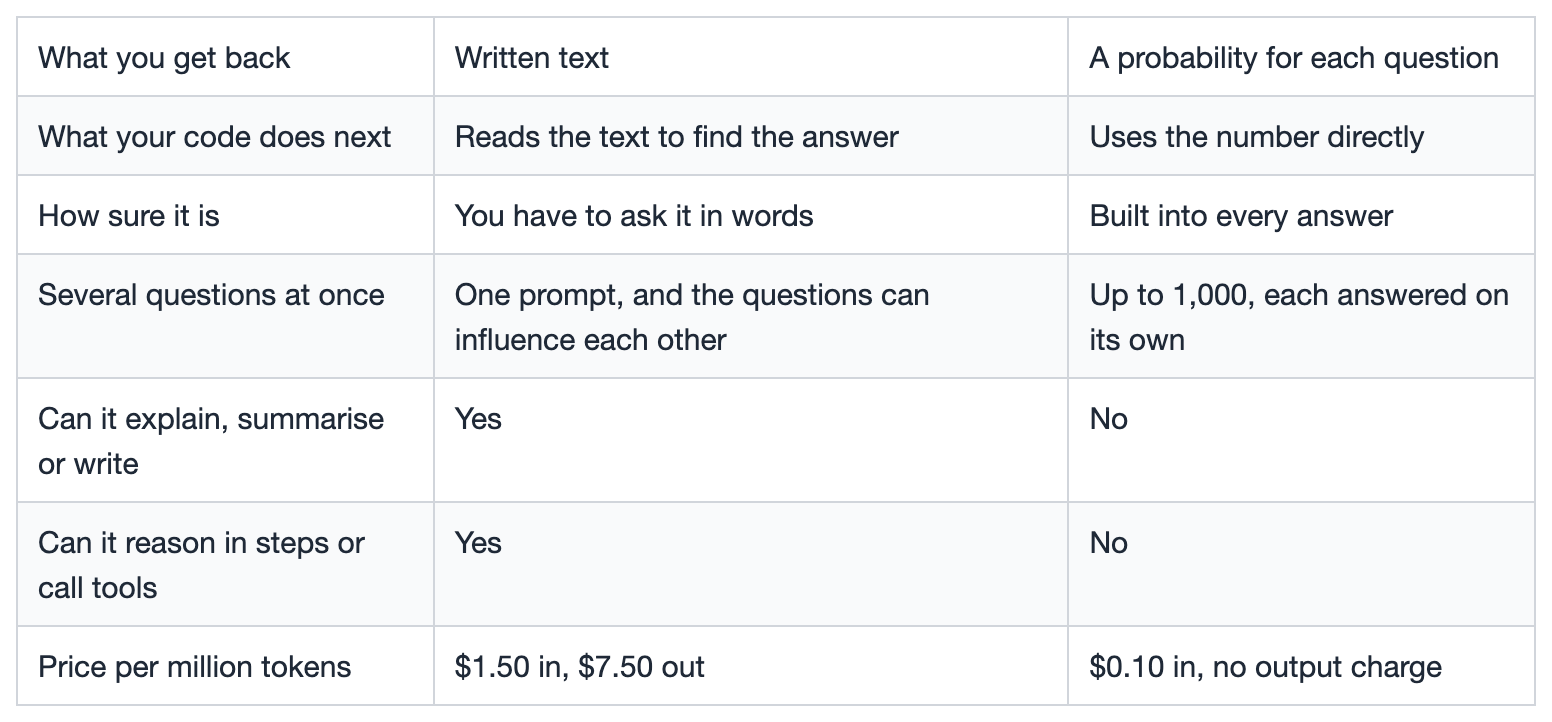
Google's guide says to use a text model when you need generated text, summaries, tool calls or multi-step reasoning. While a text model can explain its answer, Decision 1 only decides, and it suits jobs where speed, cost and an honest confidence number matter more than an explanation.
How did I test it?
Which questions did I use?
I used BoolQ, a public question set from Google. Each item has a short paragraph, a yes/no question about that paragraph, and a known correct answer. I took 400 items from the validation set. Here are four of them, with what the model said:
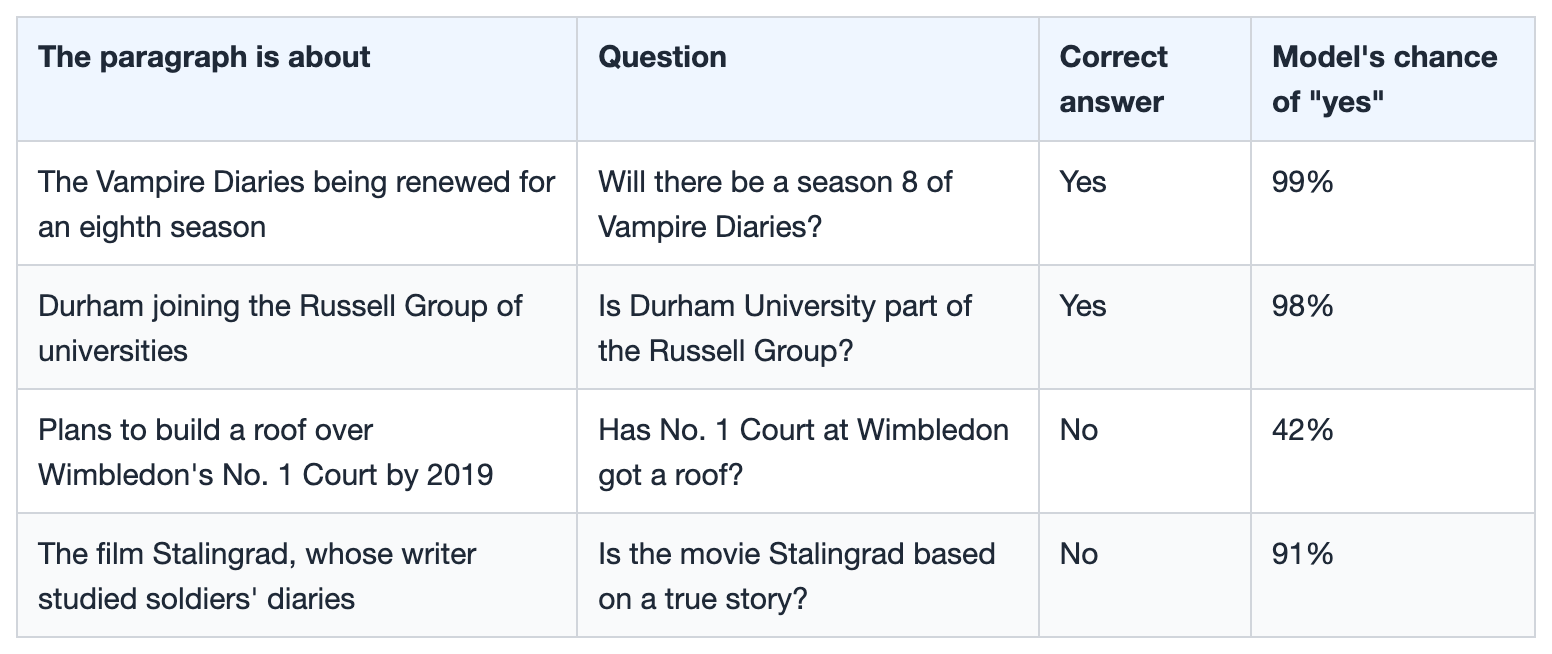
The first two are easy and the model is sure. The third is unclear from the paragraph and the model says so, while the fourth is one it got wrong.
What did I ask the model?
For each of the 400 items I made three calls:
- The question alone, which is the answer I scored for accuracy and confidence.
-
The same question bundled with other versions of it in one request, including:
- the question as a two-option choice, with "no" listed first
- the same choice with "yes" listed first
-
The opposite question. I kept the wording the same and flipped what "yes" means, using the API's
true_descriptionandfalse_descriptionfields. A consistent model should now give the opposite answer.
That is 1,200 calls in total. I compared every answer with the known correct answer, and the versions with each other.
Can I trust its confidence?
Yes. I grouped the 400 answers by how sure the model said it was, then checked how often each group was right.
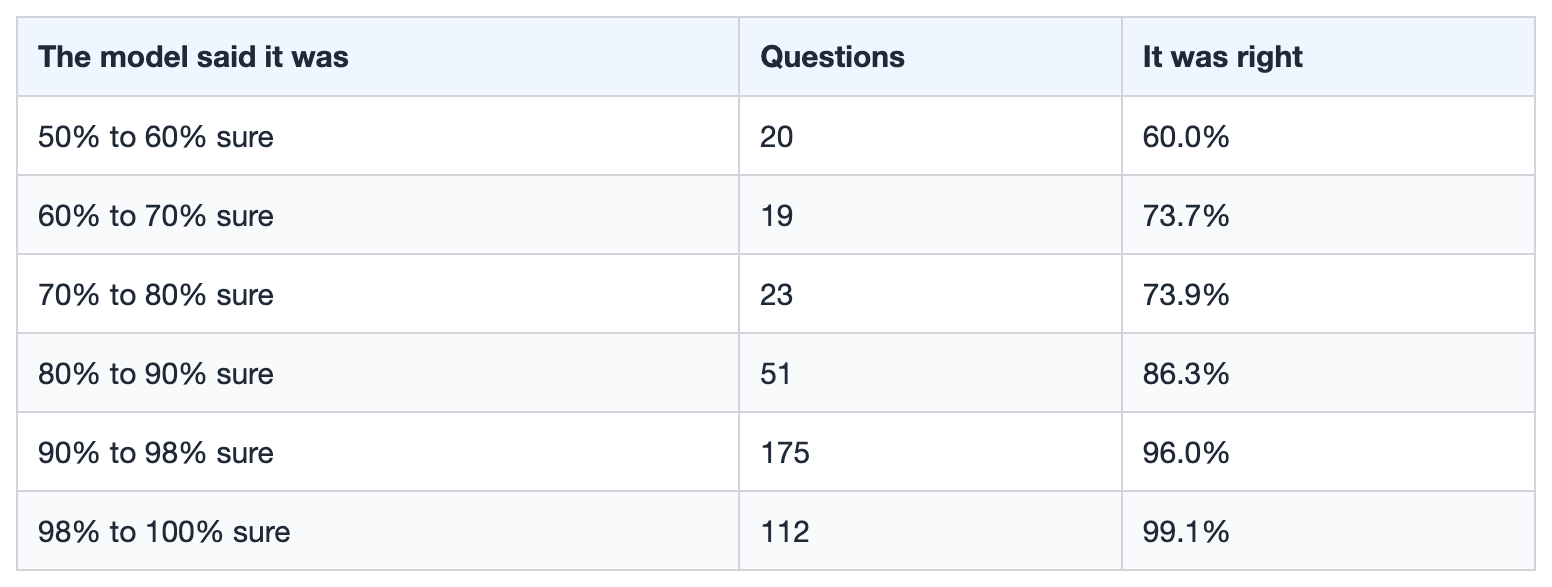
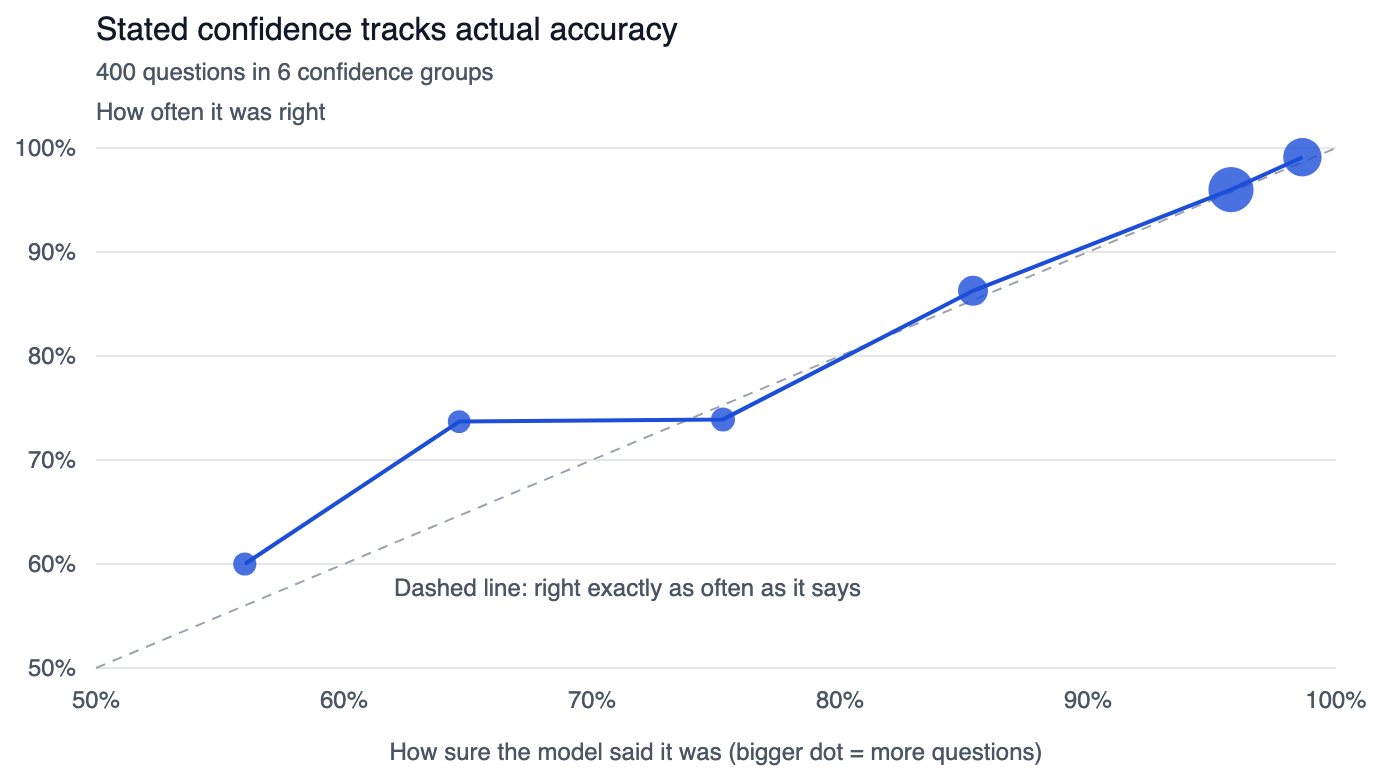
The two columns track each other closely. On average, the gap between what the model claimed and what happened was about 2 percentage points. However, the top three rows have around 20 questions each, so treat those as rough.
What does this let you do?
Since the number is honest, it can be used as a gate. You accept the answer when the model is sure enough and pass the rest on.
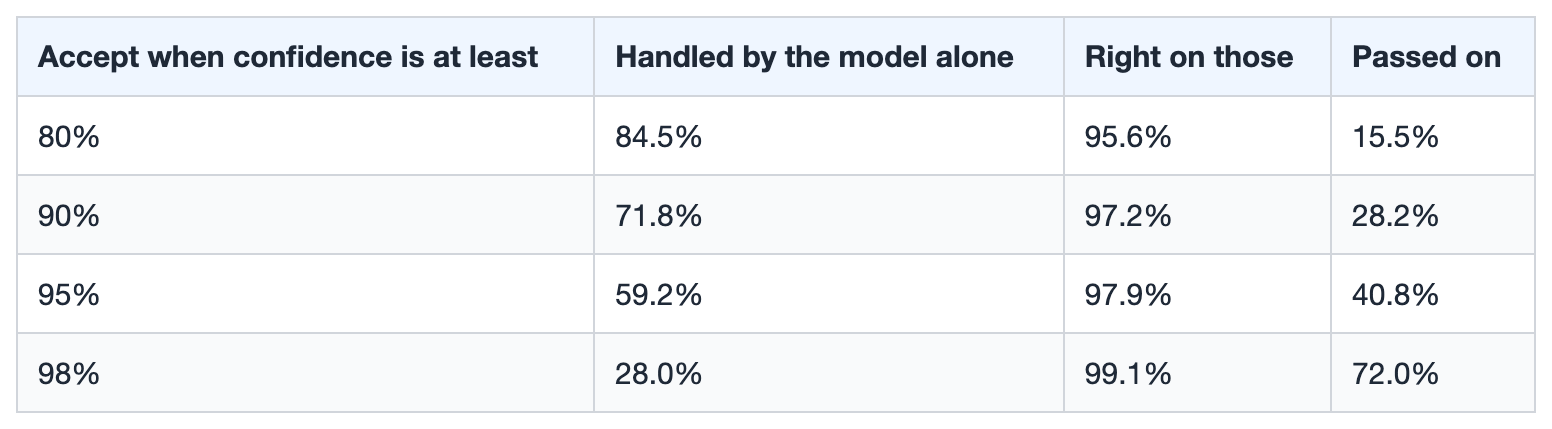
At a 90% cut-off the model handled 72% of the questions and was right on 97% of them.
Is it consistent?
On three of the four checks it was, and the fourth fails mostly on questions the model had already marked as unsure.
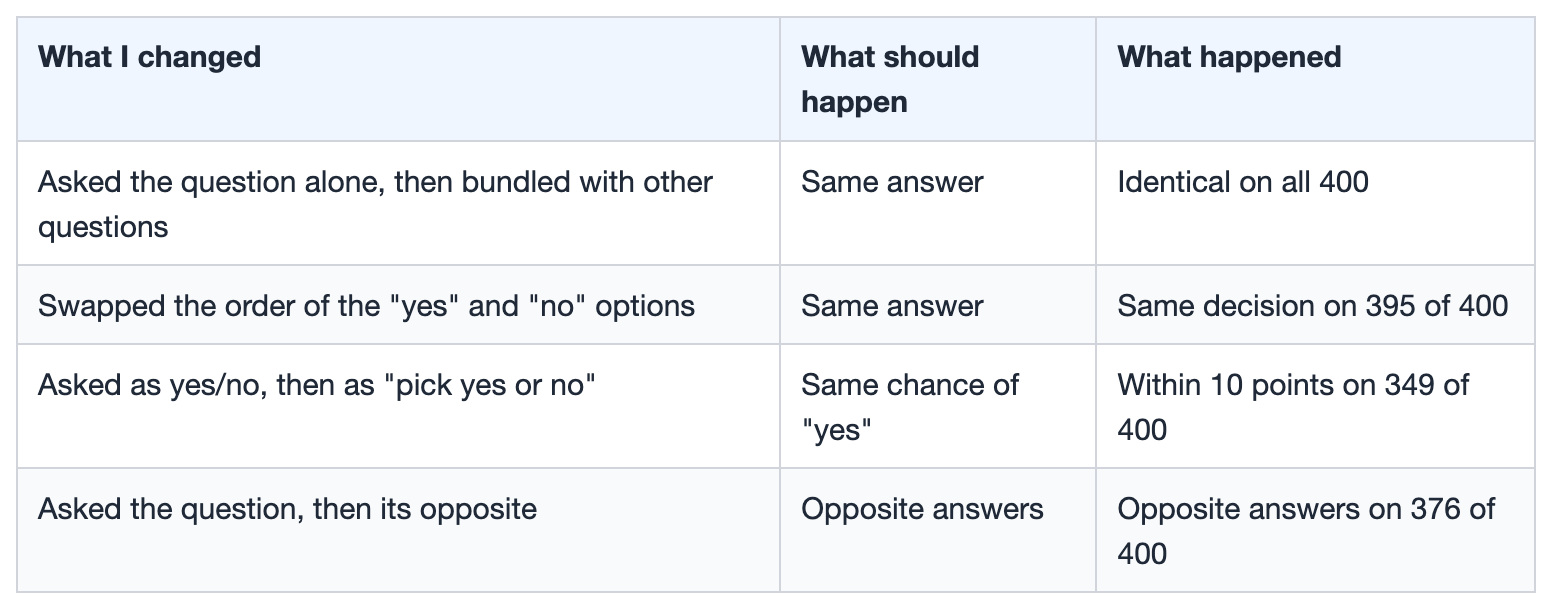
The first row confirms something Google states, which is that questions in one request cannot see each other. Every one of the 400 came back identical, so bundling is safe. The order of the options barely mattered either.
I also ran the whole test a second time on the same day and every answer came back the same, so the results are repeatable.
I looked at the last row more closely. On 24 of 400 questions, the model gave the same answer to a question and to its opposite. However, those 24 are mostly questions it was already unsure about:
- On 19 of the 24, its confidence in the original answer was below 80%.
- Only 1 was a question it was at least 90% sure about, out of 287 such questions.
Let's take one example. The paragraph says many people believe a ship's captain can perform marriages, but that it depends on the country. Asked "Can a ship's captain legally marry a couple?", the model said yes at 52%, which is close to a coin flip. Asked the opposite, it leaned yes again, at 70%. The first answer's confidence was already low enough to send this question to a person.
The model's unsteady answers are the ones it marks as unsure. Therefore, the confidence gate from the previous section already sends them to a person.
How does it do on a real task?
To see it on something closer to real work, I wrote 10 made-up customer messages and asked five questions about each in a single call:
from google import genai

client = genai.Client(http_options={"api_version": "v1beta"})

result = client.decisions.create(
    model="gemini-decision-1",
    input=ticket,  # one customer message
    questions={
        "department": {
            "type": "choice",
            "instructions": "Which team should handle this customer message?",
            "criteria": {
                "billing": "Charges, refunds, invoices and payments",
                "delivery": "Shipping, tracking, late or missing parcels",
                "technical": "Login, account settings, app or website problems",
                "product": "A fault or complaint about the item itself",
                "other": "None of the other teams fits",
            },
        },
        "urgent": {  # "noul" is what the Decisions API calls a yes/no question
            "type": "noul",
            "instructions": "Does this customer message need a reply within the hour?",
        },
        # ...three more yes/no questions: angry, wants a refund, contains personal details
    },
)

print(result.answers["department"].choice)  # the team it picked
print(result.answers["urgent"].noul)        # chance of "yes", from 0.01 to 0.99
Five of the ten results:
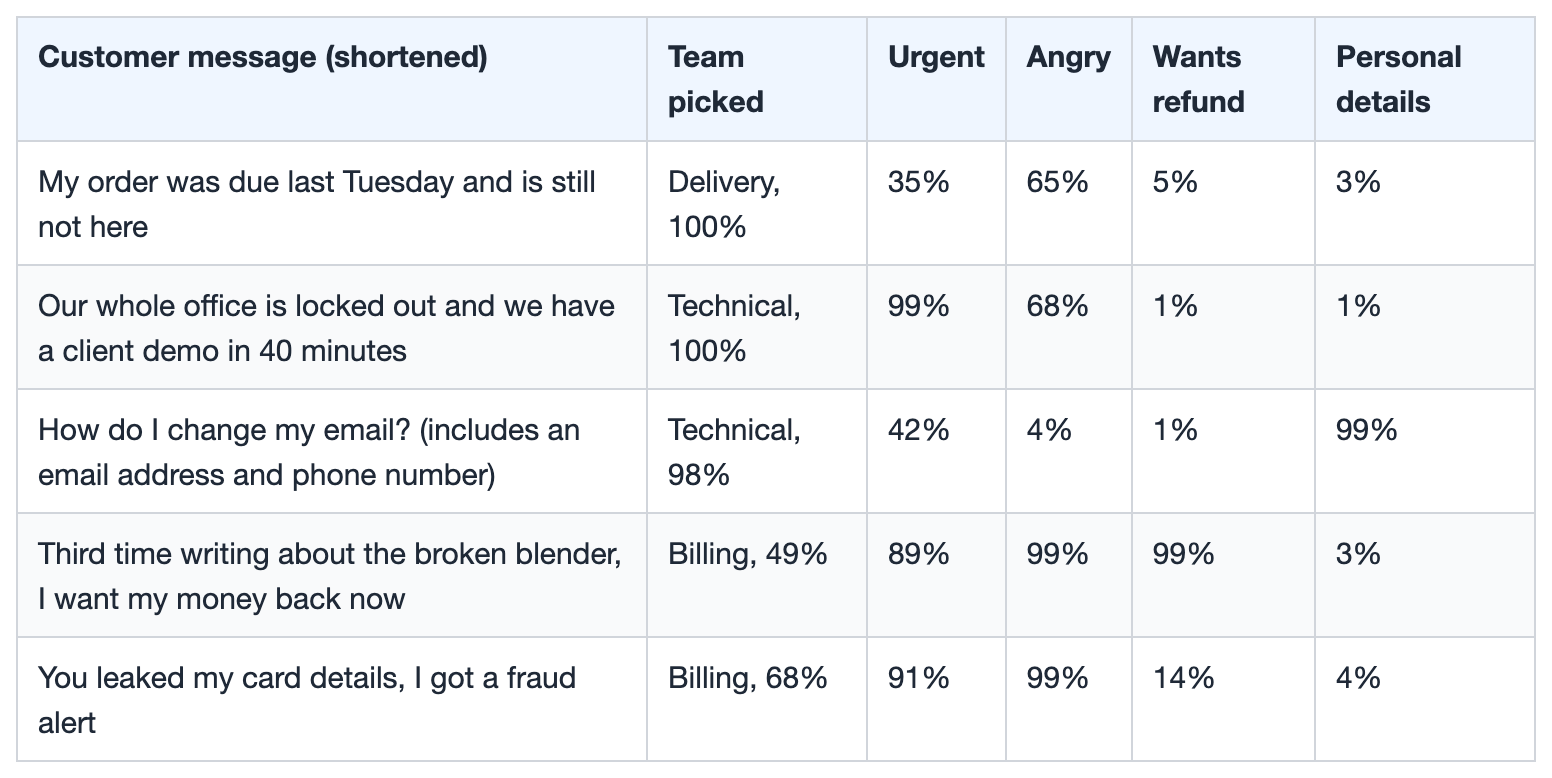
Each call took about 0.7 seconds. The clear cases came back with high confidence, while the unclear ones did not. The broken blender is both a faulty product and a refund request, and the model split 49% billing, 46% product. A split like that is the signal to send the ticket to a person.
There is no answer key for these messages, so I cannot score them. Treat this section as a demonstration.
What should you take from this?
- Use the confidence number. It was honest in my test, so pick a cut-off, let the model handle what clears it, and pass the rest to a person or a larger model.
- Choose the cut-off with your own examples. My 90% figure comes from quiz questions, and Google's guide gives the same advice: set thresholds using labelled examples from your own data.
- Word questions directly and try them on a sample. Keep each question plain and complete. If you need to define what "yes" means, use the API's
true_descriptionandfalse_descriptionfields. - Bundle questions freely. Asking three questions took the same time as asking one, and the answers did not change.
- Never set a cut-off above 99%. Yes/no answers are capped between 1% and 99%, so such a rule would never fire.
What are the limits of this test?
- The sample is 400 questions from one public dataset, run on 22 November 2026, so it shows a direction and should not be read as a benchmark.
- The model may have seen these questions. BoolQ is public, so it could be in the training data, which would flatter the accuracy.
- The answer key is not perfect. BoolQ has some wrong labels, which caps the score any model can reach.
- I tested only text and did not try images, audio, video or PDFs.
- I tested one model. TypeSafe's Jev, announced in September 2026, works on the same idea, and I will compare the two in my next post.
How fast and how cheap was it?
Links
- Decisions API guide: https://aistudio.google.com/docs/decisions-api
- Model page: https://aistudio.google.com/docs/models/gemini-decision-1
- Pricing: https://aistudio.google.com/docs/pricing
- BoolQ dataset: https://huggingface.co/datasets/google/boolq